




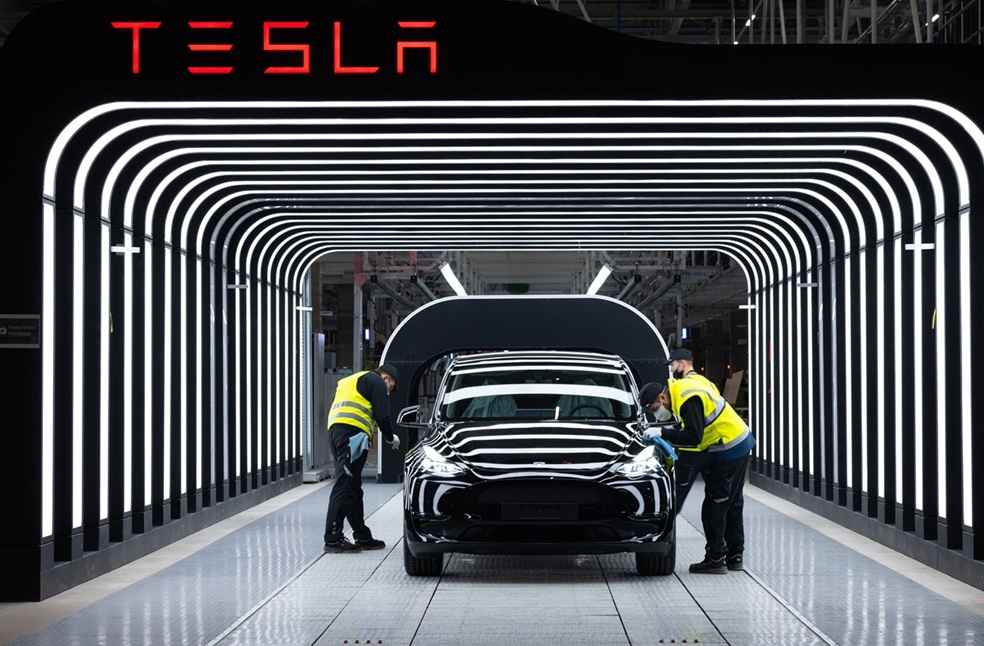
Tesla CEO Elon Musk has rejected reports that the company is considering separating its China operations, describing the claim as completely false. As reported by The Wall Street Journal, Tesla was exploring options to spin off its China business to facilitate a future merger with SpaceX. According to sources familiar with the matter, discussions have included possibilities such as a spinoff, a sale, or even shutting down the operations.
Speculation over a potential merger between Tesla and SpaceX has intensified since SpaceX’s IPO last month, driven by the companies’ expanding ties and shared focus on artificial intelligence.
A separation of Tesla’s China business could impact its Shanghai manufacturing plant and may result in the shutdown of certain operations in the company’s second-largest market.
The two companies already have close operational links. Tesla supplies batteries and Cybertrucks to SpaceX, while Grok, the AI chatbot developed by xAI, is integrated into some Tesla vehicles. SpaceX also acquired Musk’s AI venture, xAI, earlier this year. In June, SpaceX President Gwynne Shotwell told CNBC that combining the businesses could simplify Musk’s responsibilities. Musk himself acknowledged during last week’s earnings call that the overlap between Tesla and SpaceX is growing but stressed that any merger would require proper procedures.
China remains Tesla’s largest manufacturing base, with the Shanghai Gigafactory capable of producing around one million vehicles annually. The plant is the company’s biggest production facility and serves as a major export hub for Europe and the Asia-Pacific region. Tesla also sources more than 95% of components for its China-built Model 3 and updated Model Y from over 400 local suppliers.
According to data from the China Passenger Car Association (CPCA), Tesla’s wholesale sales in China rose 28.39% year-on-year to 467,949 vehicles in the first half, representing 55.83% of the company’s global deliveries of 838,149 units. During the same period, exports from the Shanghai Gigafactory surged 126.58% to 228,994 vehicles.
Despite the strong first-half performance, Tesla’s domestic deliveries in China declined 2.05% year-on-year to 126,157 units in the second quarter, accounting for 26.28% of global deliveries. It marked the first time China’s share of Tesla’s global deliveries fell below 30% since the fourth quarter of 2020. Meanwhile, Shanghai plant exports reached 128,394 units in Q2, exceeding local deliveries for the first time and reinforcing the facility’s growing role as Tesla’s key export hub.
GENERAL | BMW Plans 8,000 Job Cuts by 2027 Amid Profit Decline