




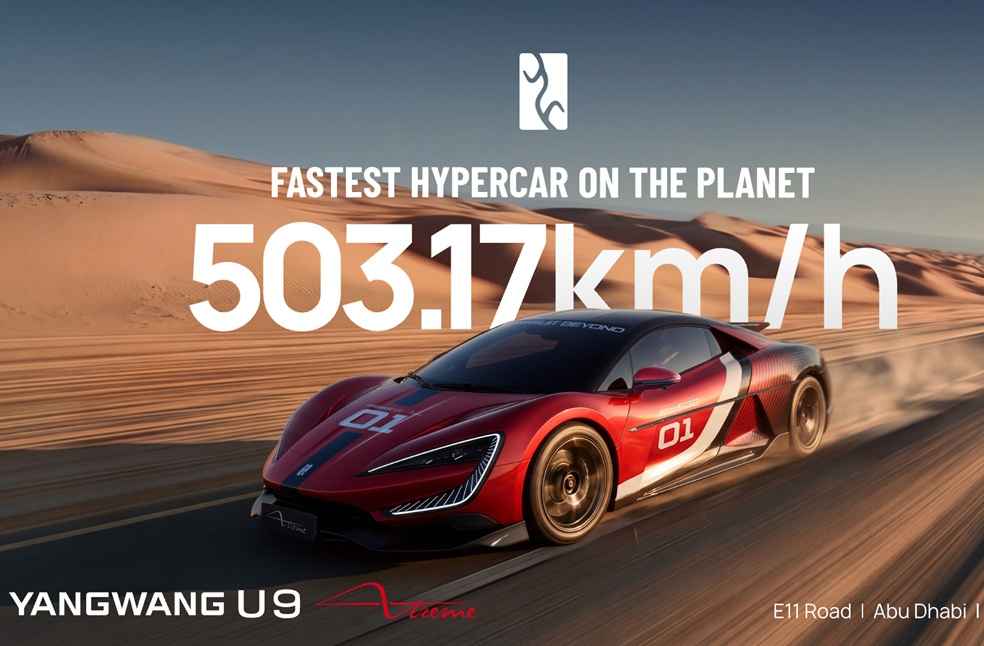
BYD’s luxury marque Yangwang has reportedly set a new production-car speed record with its U9 Xtreme hypercar, reaching 503.17 km/h (312.65 mph) in Abu Dhabi. The achievement makes it the first production vehicle to exceed the 500 km/h mark and has been officially recognized by the Fédération Internationale de l’Automobile (FIA).
BYD announced the record on X on Friday, stating the U9 Xtreme “has done the impossible” and calling it “the fastest production car on the planet.”
The record-breaking run took place on November 1 along Sheikh Khalifa Bin Zayed International Road (E11) in Abu Dhabi’s Al Dhafra region. German racing driver Marc Basseng was at the wheel, taking the hypercar beyond its previous benchmark of 496.22 km/h (308.34 mph), set at Germany’s ATP Papenburg proving ground in September 2025. The latest run exceeded the earlier record by 6.95 km/h, with the car covering nearly 140 meters per second at its peak speed.
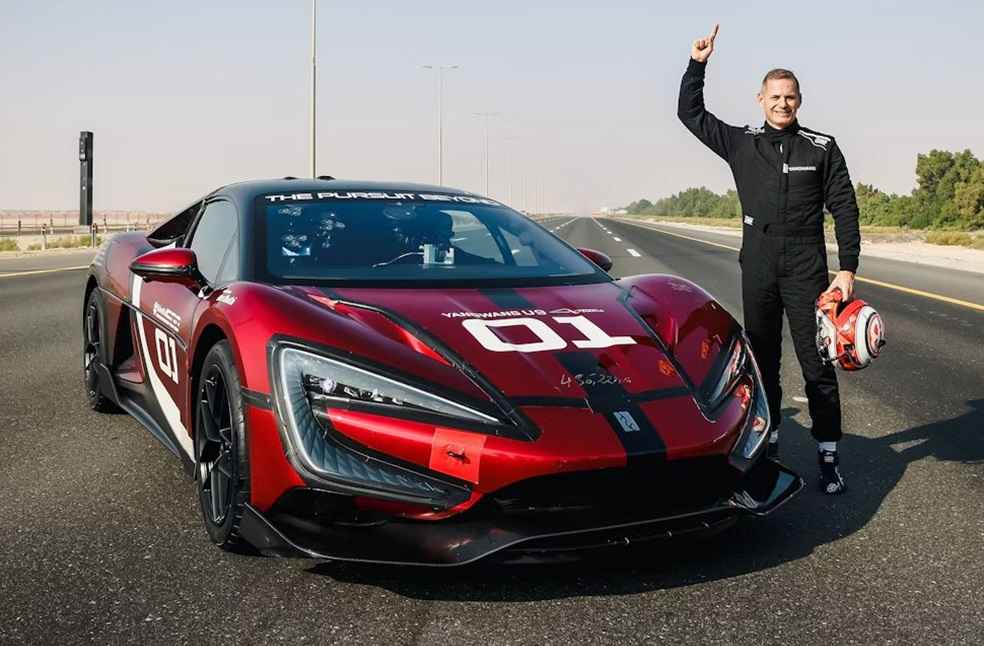
The FIA has confirmed the achievement on its official website. The U9 Xtreme has also earned two Guinness World Records for the highest speed recorded by a production car in a single-direction run and the highest speed achieved by an electric production car in the same category.
The U9 Xtreme is the high-performance variant of the Yangwang U9 supercar, built on a 1,200V high-voltage platform and engineered for extreme-speed performance. Powered by BYD’s quad-motor e4 (Yi Si Fang) system, its four electric motors can spin at up to 30,000 rpm, producing a combined output of 2,220 kW (2,977 hp). The powertrain delivers an impressive 1,200 hp per ton, while its torque-vectoring technology can adjust power distribution up to 100 times per second to maximize control and stability.
To cope with the demands of ultra-high-speed driving, BYD has specifically enhanced the vehicle’s tires, braking system, cooling architecture and body-control technologies. Aerodynamic efficiency has also been significantly improved through the addition of a large carbon-fiber front splitter, dual-channel hood, rear diffuser and tall swan-neck rear spoiler, all designed to increase downforce and stability at extreme velocities.
Production of the Yangwang U9 Xtreme will be highly limited, with BYD confirming that fewer than 30 units will be built worldwide.
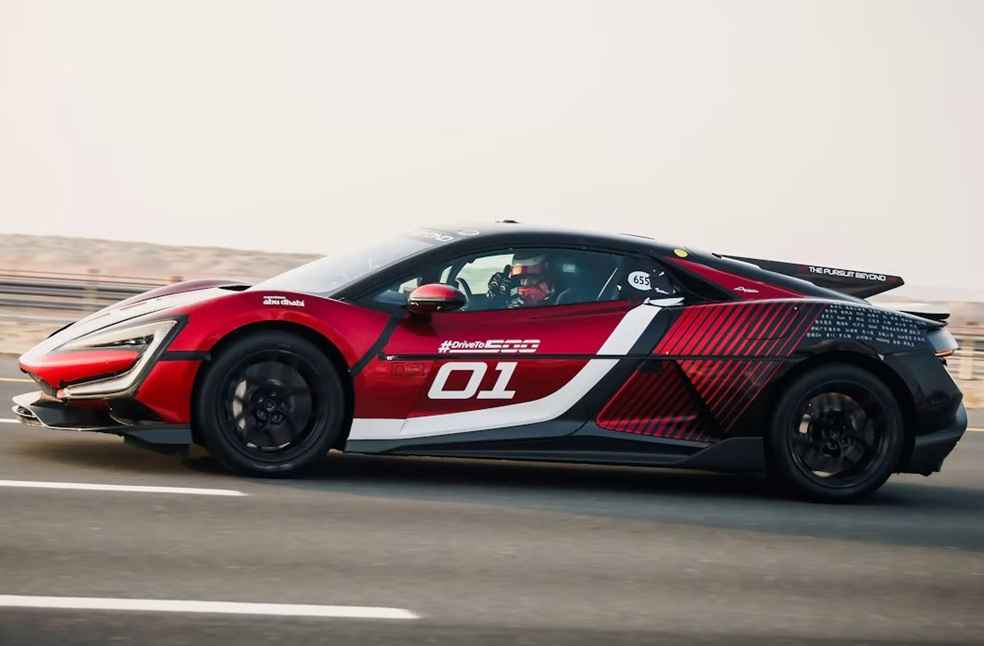
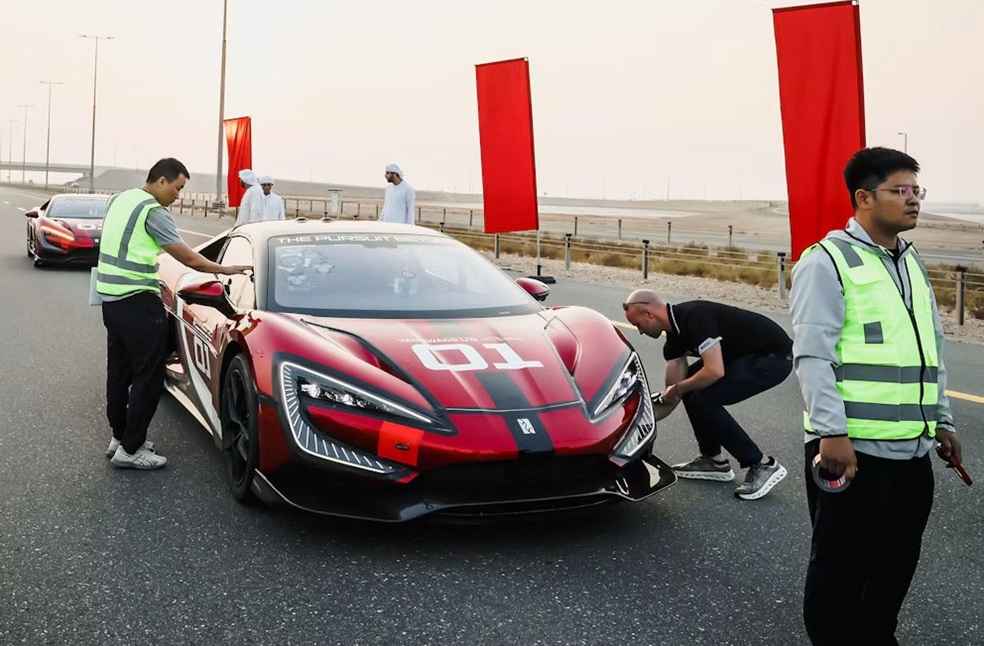
Abu Dhabi authorities closed a 10 km stretch of Sheikh Khalifa Bin Zayed International Road (E11) in the Al Dhafra region to facilitate the record attempt, providing the team with a 7 km straight section. The test was conducted over two days. According to the FIA, Basseng, who also set the previous record, reached a maximum speed of 490 km/h on the first day. Following overnight adjustments to the rear wing, suspension damping and tire pressures, he achieved 503.17 km/h during his second attempt on November 1.
The previous benchmark of 496.22 km/h (308 mph) had already surpassed the Bugatti Chiron Super Sport 300+’s 490.48 km/h record set in 2019. The latest achievement comes just days after BYD released footage showing a U9 Xtreme crashing into a guardrail at approximately 280 mph during an earlier high-speed test. The driver escaped without injuries, and the vehicle subsequently returned to the track, recording 457.89 km/h on its next run.
Tire technology also played a significant role in achieving the record. Yangwang collaborated with Giti Tire to develop specialized semi-slick tires capable of handling the extreme forces generated at such high speeds. The wheel-to-rim interface was also specially engineered to minimize tire slippage during acceleration and braking.
Beyond its record-breaking top speed, the Yangwang U9 Xtreme has also demonstrated impressive track performance. The same version of the hypercar completed a lap of Germany’s Nürburgring Nordschleife in 6 minutes and 59.157 seconds, earning the title of the fastest production electric vehicle to lap the iconic circuit. This combination of exceptional straight-line speed and track capability makes the achievement particularly notable. While developing a vehicle capable of exceeding 500 km/h is a significant engineering feat, building one that can also complete the challenging Nürburgring circuit in under seven minutes represents another level of performance.
However, a single-direction speed record is different from an officially verified two-way average, meaning the achievement does not resolve every debate over the world’s fastest production car. Nevertheless, FIA recognition lends considerable credibility to the U9 Xtreme’s accomplishment, marking a significant milestone for China’s automotive industry and the global electric hypercar segment.
TOP CARS | Tesla Debuts New Roadster Nearly a Decade After its First Reveal