




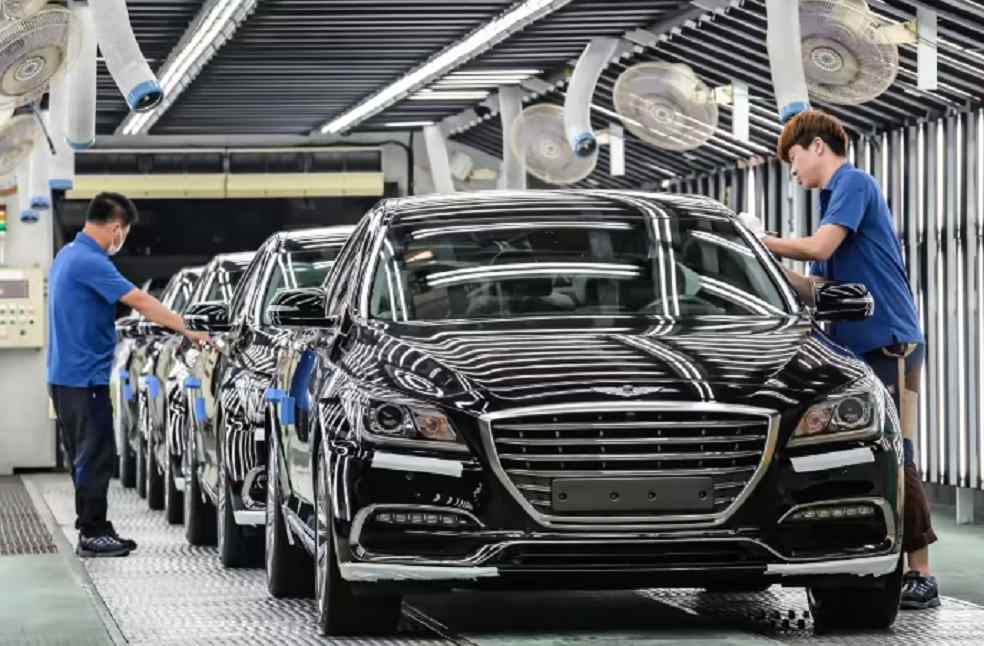
South Korea’s auto industry, a cornerstone of its economy, faces a severe threat from the current 25% U.S. tariff on Korean vehicles and parts, significantly higher than the 15% rate applied to Japan and the European Union.
Analysts warn that the tariff could trigger a near-collapse of exports, endangering domestic production and employment.
Although South Korea and the U.S. agreed in principle to a 15% tariff in July, the deal has not been formalized, leaving the higher rate in place amid complex U.S. domestic politics and broader geopolitical negotiations.
The Trump administration appears to be leveraging the pending agreement to gain an advantage in other trade and defense discussions.
A global trade simulation using a computable general equilibrium model predicts catastrophic effects if the 25% tariff remains. Korean auto exports to the U.S. are projected to drop by 61.2%, pushing the industry to an ‘export cliff.’

Domestic output of vehicles and auto parts could fall by over 10%, while South Korea’s real GDP may contract by 0.24%, translating to an annual loss of approximately $54.87 billion (7,681.8 billion won).
Upstream suppliers, including steel and fabricated metals, are expected to suffer widespread industrial slowdown, increasing the risk of mass layoffs and bankruptcies.
The tariff structure places Korean automakers at a competitive disadvantage. Japan enjoys a lower 15% tariff, giving its exports a 10%-point edge, while tariff-free imports from Canada and Mexico further distort the market.
South Korea’s total auto exports are projected to shrink by 17.5%, compared with a 10.4% decline for Japan.
Ironically, the United States faces economic drawbacks despite a modest 6.6% increase in domestic auto production. Consumers will face higher vehicle prices, and overall inefficiencies could cost the U.S. economy $26.9 billion, with a real GDP contraction of 0.16%.
The policy’s aim appears to be the creation of a “North American automotive bloc,” benefiting Canada and Mexico through trade diversion, while disrupting global supply chains.
Experts argue that urgent strategic measures are needed to mitigate the impact. South Korea must pursue coordinated diplomacy to finalize the 15% tariff agreement, increase U.S.-based production, and diversify export markets, including ASEAN and India.
Expanding manufacturing investments in North America and advancing next-generation automotive technologies such as electric vehicles, autonomous driving, and advanced batteries are also essential to maintain competitiveness despite tariff pressures.
The findings underscore a critical vulnerability in South Korea’s heavy reliance on the U.S. market. Immediate, coordinated action from both government and industry is required to safeguard the nation’s automotive sector, stabilize employment, and sustain economic growth.
NEW LAUNCH | Greenhous Group Adds Geely, Expands UK Chinese Auto Portfolio