




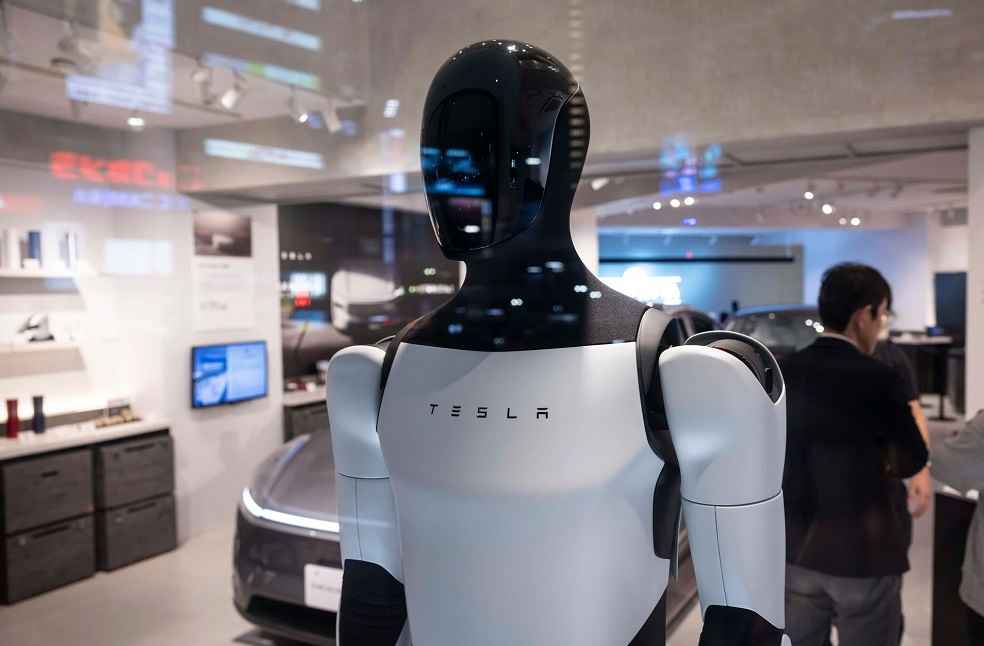
Tesla has unveiled a major update to its humanoid robot, Optimus, releasing new footage that highlights a significant jump in agility and human-like movement.
A short clip posted on X on December 3 by both the official Tesla Optimus account and CEO Elon Musk shows the robot running inside a controlled lab environment, quickly gaining widespread attention online.
Standing 5 feet 11 inches tall and weighing 160 pounds, Optimus features more than 40 degrees of freedom and 11-DoF hands designed for fine motor control.
The unit is powered by a 2.3 kWh battery built to support nearly a full day of operation. Energy use ranges from 100W at rest to 500W while walking, underscoring Tesla’s efforts to optimize efficiency in humanoid robotics.
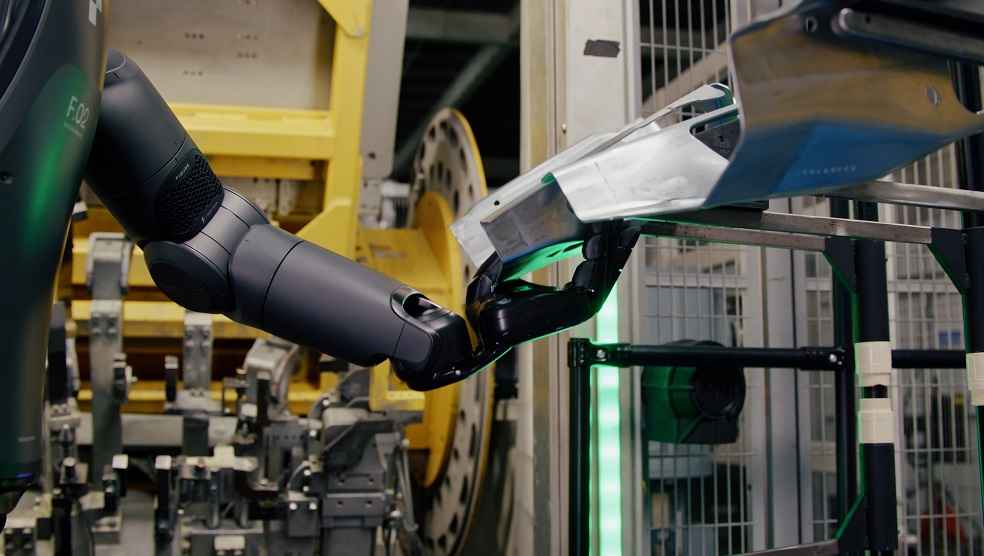
Earlier demonstrations had shown cautious walking, balance tests, and simple object handling. The new video indicates sharper coordination, better stability, and a gait that is far more natural compared with earlier prototypes.
A second clip circulating widely contrasts Optimus’ movements in May 2023 with its December 2025 performance.
The comparison highlights a dramatic improvement: from slow, supervised steps to confident strides with improved rhythm and full-body control. The accelerated progress is attributed to Tesla’s internal AI systems and its focus on scalable robotics development.
Musk has maintained that Optimus is intended for real industrial deployment, not merely research. His target is to field 5,000 robots by the end of 2025, primarily across Tesla’s factories. By mid-2025, Optimus was already demonstrating longer autonomous walks, light object lifting, scripted pick-and-place actions, and basic assembly-line functions.
In September, Tesla introduced the ‘2.5 Gen Optimus,’ followed by an updated version in October capable of controlled martial-arts-style movements with a professional trainer.
Tesla says the robot is still under development but moving closer to mass production. Once scaling is achieved, Musk estimates a price range of $20,000 to 30,000, making it cheaper than many industrial robotic systems. Musk has also floated the concept of robots eventually manufacturing other robots once the ecosystem stabilizes.
The timing aligns with broader shifts in the global auto industry. As electric vehicles and humanoid robots share core components such as batteries, AI processors, and sensor systems, the convergence between mobility and robotics is accelerating.
Automakers worldwide, including in India, face labor shortages and rising operational costs, prompting a stronger push toward automation and next-generation manufacturing tools.
Although Tesla’s roadmap remains ambitious and at times polarizing, industry analysts note that humanoid robotics is emerging as a serious frontier.
Whether Optimus sets the benchmark remains uncertain, but its latest demonstration marks a notable step toward Musk’s vision of integrating humanoids into large-scale EV production and reshaping industrial automation in the coming years.
NEW LAUNCH | Ceat Expands Global Push With Region-Specific Tire Development