




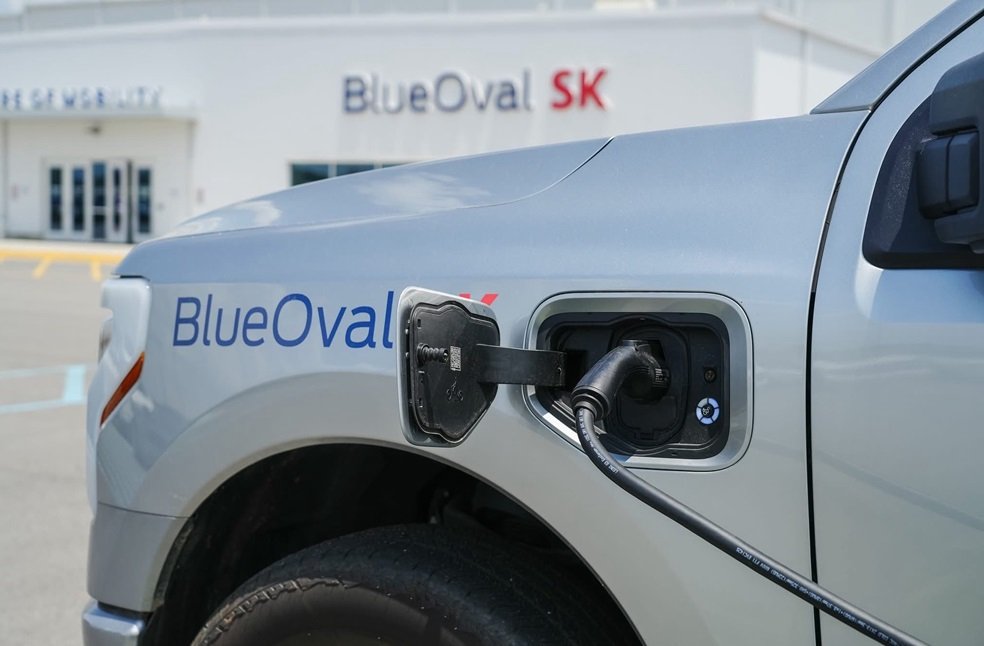
Ford and SK On have agreed to dissolve their U.S. battery manufacturing joint venture, BlueOval SK, splitting ownership of three large facilities before construction has been completed.
Under the agreement, South Korea’s SK On will take full control of the Tennessee plant, while Ford will assume both Kentucky sites. Regulatory approvals are expected by the first quarter of 2026.
The joint venture, established in 2022, committed $11.4 billion to building three factories with a combined annual capacity of 120 GWh, enough to power roughly 1.2 million electric vehicles.
Only one of the Kentucky plants is operational, while construction of the Tennessee facility and the second Kentucky site has been pushed into 2026 and later, reflecting the slowdown in U.S. EV demand.

The split also aligns with Ford’s broader strategic shift. The automaker has been scaling back near-term EV plans and increasing its focus on hybrids and lower-cost electric models.
It is also moving toward lithium-iron-phosphate battery chemistry, which is cheaper but not part of SK On’s current automotive portfolio. The Korean battery maker continues to produce nickel-cobalt-manganese cells and does not yet have commercially competitive LFP technology for vehicles.
SK On, which supplies batteries to Hyundai Motor, Kia, Volkswagen, Nissan, and U.S. startup Slate, is separately building a $5 billion plant with Hyundai Motor Group in Georgia. The company confirmed to the Korean JoongAng Daily that it will continue supplying Ford from the 45 GWh Tennessee facility.
In a statement, SK On described the decision as “a strategic realignment of assets and production scale to enhance operational efficiency,” adding that it intends to expand its North American footprint while focusing on profitability and broader supply to EV and energy-storage customers.

Ford’s retreat from some EV commitments has accelerated in recent months, including slowing production of the F-150 Lightning and prioritizing hybrids and more affordable electric options. Global EV sales, especially in the U.S., have fallen short of early forecasts as high prices, shifting political support, and consumer caution weigh on adoption.
With full ownership of the Tennessee plant, SK On now holds two wholly-owned U.S. manufacturing sites alongside its 22 GWh facility in Commerce, Georgia.
The company plans to convert part of the Georgia plant’s nickel-cobalt-manganese lines to produce LFP batteries for energy-storage systems, targeting mass production in the second half of 2026. Together, the Tennessee and Georgia operations will provide SK On with 67 GWh of annual capacity under independent control.
TRENDING | Champagne Defends Stellantis Deals as MPs Demand Job Guarantees