




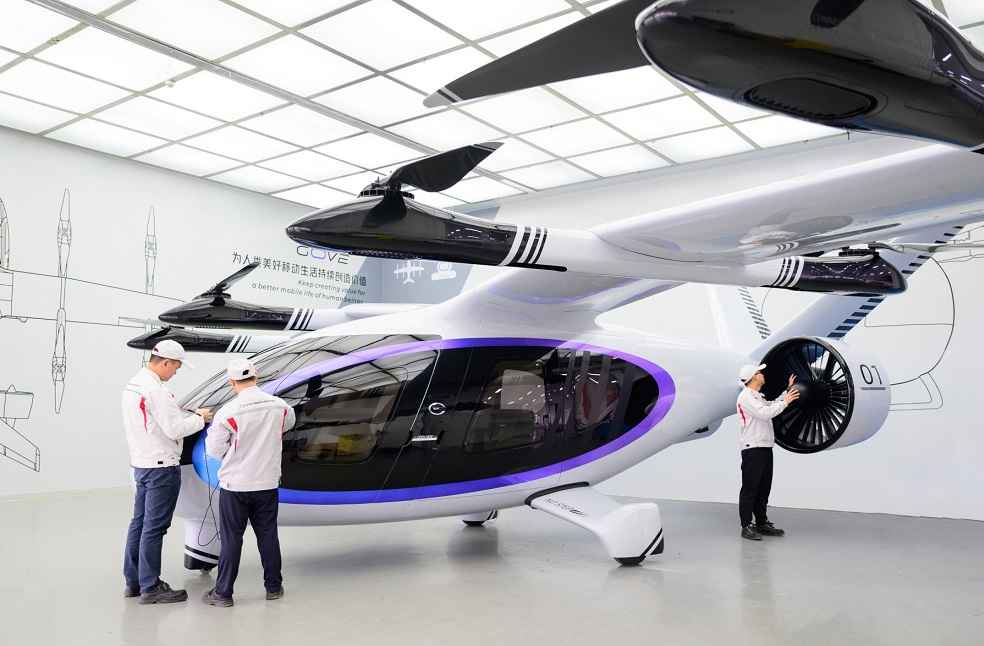
China’s fast-growing expertise in electric vehicles and drones is giving its emerging flying car industry a head start, as companies move from prototypes to early-stage mass production with strong government backing.
Inside a brightly lit factory in Guangzhou, a worker inspects the propellers of a two-seater aircraft newly assembled on the production line. The site, operated by Aridge, a subsidiary of Chinese EV manufacturer XPeng, is trialling mass production of modular flying vehicles capable of vertical take-off.
The lightweight six-propeller craft attaches to a wheeled ground vehicle known as ‘the mothership,’ forming what the company calls the ‘Land Aircraft Carrier.’ Aridge says the factory, once fully scaled, can produce one unit every 30 minutes.
Trial production began in early November, and the company plans to begin deliveries next year, claiming more than 7,000 pre-orders.
Despite global hype, technical and regulatory barriers have long held back the flying car sector. China, however, is attempting to leverage its well-developed EV supply chain, drone expertise, and supportive policy environment to secure an edge.
“China has the potential to establish a competitive advantage,” said Zhang Yangjun, professor at Tsinghua University’s School of Vehicle and Mobility. He noted that future competitiveness will depend heavily on cost control and supply-chain efficiency, areas where China already performs strongly.
Even so, industry leaders acknowledge major obstacles remain. “Regulations, consumer comfort, airspace management, and supply chains all need to catch up gradually,” said Michael Du, vice president of Aridge.
Competition is intensifying worldwide. Tesla CEO Elon Musk recently hinted that his company would unveil a flying car prototype within weeks, describing it as ‘crazier’ than all James Bond vehicles combined.

While experiments with flying cars date back to Glenn Curtiss in 1917, practical designs have only become viable with advances in electric motors and high-performance batteries.
Several companies have completed manned test flights, including U.S.-based Joby and Archer, and Chinese firms Aridge, EHang, and Volant.
This year, EHang became the first flying car company globally to secure full approval for commercial operations, ahead of Aridge. It plans to launch an air taxi service within three years, priced similarly to premium road transport.
Zhang, who edited a white paper on China’s flying car industry, said the sector remains at an early stage but is worth sustained long-term investment.
That view aligns with Beijing’s priorities, as authorities have designated the ‘low-altitude economy,’ encompassing flying cars, drones, and air taxis, as a strategic development area for the next five years.
Regional governments in Guangdong, Sichuan, and elsewhere have pledged to ease restrictions to accelerate progress.
A report from Boston Consulting Group said China’s flying car industry is nearing ‘a critical inflection point,’ forecasting a market value of about 41 billion dollars by 2040.
While the model has struggled to gain traction elsewhere, with bankruptcies in Europe and cash-burning delays in the United States, China’s position is strengthened by its dominant EV supply chain.
“China is far in the lead,” said investor Brandon Wang, whose portfolio includes AI, robotics, and flying car ventures.
He noted that aviation-certified EV components could help Chinese manufacturers scale more rapidly and that the country benefits from an ‘engineer dividend,’ enabling firms to solve technical problems at high speed.
EV WORLD | Toyota Expands Smart Charging Across Europe with New Partnerships